Tuesday, November 19, 2013

Review - Pacific Rim


In his "State of Cinema" talk, Steven Soderbergh talked about "Mayhem Porn."  In his example, this refers to viewing clips from action movies that feature nothing but the fighting, the explosions, the nasty bits, while passing on the rest, i.e., narrative, dialogue, plot.  Throughout the rest of his talk, Soderbergh talks about cinema versus movies.  The former is something that is made and the latter is something that you watch.  The former is an idea created and presented by a filmmaker and the latter is a product manufactured and tested by studios.  These two entities have various relationships.  The most obvious one being contentious.  Though some directors, such as Christopher Nolan, have managed to shroud the former in the latter.  And while Nolan's earlier films are more interesting the Batman trilogy and Inception managed to sneak in a bit of substance when the lights went down for those films.  So, while there are filmmakers out there doing strong genre work, there is also an enormous and ever-growing amount of bullshit built on existing IP that are nothing more than extended commercials which these studios use to slacken our jaws and sell us toys and corn-based products and Halloween costumes. These films perform exceedingly well financially and are the bread and butter of studios.  The public continues to shell out its twelve dollars even in an economy that has been stagnant with regard to wage raises and employment. 

All this is to say, that while I do understand the shifting dynamics of entertainment and substance, people's willingness to pay for spectacular, albeit banal, entertainment, and the desire to surf on the wave of what is currently hot:  Why the fuck is everyone so enamored with such mediocre garbage?  This is not a plea to stop watching crap.  There is a great need for spectacle.  For garbage.  Sometimes it is just about escaping.  Everything you consume need not be meaningful in, and of, itself.  Though (and here is the main takeaway) just because you like something, does not mean it is good and just because something is good, does not mean you have to like it.  This is what discourse is for and, by extension, what art is for.  Why is something good?  Why is something boring?  What is the point?  Is that point meaningful? Why should I give a shit?  Indeed, why should you?   

Which brings me to my next talking point, Pacific Rim.  A mediocre film if ever there was one.  If I were grading it I would mark it a "C".  The film succeeds completely during the robot/monster portions and fails completely during the character portions and so "C" is a nice, round average.  The world of the Kaiju (monsters) and Jaegers (mechas) is rich and interesting.  The writers and Del Toro spared no detail creating a convincing space in which these fantastic beings could collide at inhuman speeds.  Anyone who has seen Del Toro's other work knows that world-building is his specialty.  There is a deep history of the Kaijus attacks and humanity's many attempts at thwarting them.All of the Kaijus and Jaegers are named and are distinguishable from the rest of their respective cohorts.  (A rare feat in the giant robot fight movie.)   And a lot of time was also spent on the physics of the behemoths.  The Kaiju are quick and agile like their reptile brethren.  They swim with ease and some can even fly.  In short, they move naturally like animals.  Jaegers, on the other hand, lumber about, wading through water one big step at a time.  They can be quick but they move like what they are: machines.  The match up of these two forces is thrilling to watch.  Jaegers beat down their slithering foes with repeated punches but the Kaiju can turn the tide in a moment, its sinewy claws tearing through plate metal and shifting gears. 

On a nostalgic note, this a strong entry in two great traditions.  The Kaiju tradition includes characters such as Godzilla, Gamera, and Rodan.  While the Jaegers are born out of the mecha tradition which includes Macross, Gundam, and Neon Genesis Evangelion.  What we are treated to is a large scale battle of nature versus technology, all in the name of preventing the apocalypse.  Anyone interested in living out their vicarious Power Ranger fantasies need to stop reading and go see this movie.

All of that enjoyable mayhem is vastly encumbered by the trite characters and their meaningless conversations about nothing.  The plot is filled with so many clichés it is as if the story was just mended on last minute so that this could be a feature film instead of a SyFy special:  Robots v. Aliens!

Let us count the clichés:

1.  Character sustains a loss fighting the enemy and so the character is unfit to fight.  The character inevitably must fight.  This includes two main characters: Raleigh and Mori.  Tiresome dialogue about being the best but not being fit ensue.  This does not work because it is telegraphed early in the film that these characters will undoubtedly fight, undoubtedly win, and probably live.  Interestingly enough, this was used in Skyfall, but it was not tiresome.  Rather it was used to undermine and expand the Bond archetype, which is what the Daniel Craig/Bond films have been doing all along. 

2.  Character almost dies doing something.  They will die if they do it again.  Character is compelled to do it again.  Stacker will die if he pilots a Jaeger again.  Read:  Stalker will pilot a Jaeger again as a sacrifice to the cause.  Self-sacrifice  is an interesting narrative arc and should potentially read as an amazing moment.  But after years of film and television and fine tuning through focus groups, this contrived and (again) trite plot device is telegraphed early.  Of course he is getting in the Jaeger and dying.  An argument here would be, "Of course he is going to fight, it is the apocalypse."  While that is true, it only serves my point.  The plot has been manufactured to serve the dramatic end of this character through self-sacrifice.  I am looking at you Randy Quaid in Independence Day.

3.  Dramatic training sequence wherein the main characters/love interests spar and gain respect for one another while ramping up sexual tension.  Neo and Morpheus.

4.  Pointless rivalry between hero and a team member that turns into mutual respect because.
"You can be my wingman anytime."  Need I say more?

5.  Obligatory battle pep talk.  "We are canceling the apocalypse."  "They may take our lives, but they'll never take our freedom."  "Today we celebrate our independence day."  "For you are in Elysium, and you are already dead."

6.  The hero lives when he clearly should not.  A la The Dark Knight Rises

There are more but this should suffice.  The plot is in service of sequences featuring robots fighting monsters, which are infinitely more enjoyable.  Screenplay writer Travis Beacham said that in an early draft Raleigh and Mori were meant to not understand one another until late in the film when they had drifted multiple times.  This idea alone is more interesting than anything presented by the film.  In that scenario, the audience is presented with humanity's struggle of coming together in a very real way.  If we cannot communicate, how can we make a concerted effort?  And in that case, what is our case as a worthwhile species to keep possession of our property, i.e., earth?

To take it back to the point made earlier.  I like this film, but I do not think it is good.  It is an entertaining, rainy action romp that fails only when it lets up.  The dialogue and character scenes should be offering a dynamic opposition to the big fight scenes but they are times for hitting the bathroom and mocking our heroes.  (Certainly the latter is a favorite past time.)  So when Soderbergh talks about mayhem porn I have to disagree with him in this case.  I could not abide anything but the mayhem.  At least it is interesting to look at.


Tuesday, October 29, 2013

The Counselor: A Response to the Defenders


Is anyone else tired of reading these reactionary pieces from critics defending The Counselor?  I have read Scott Founda's 'Rearview' for Variety and Devin Faraci's "In Defense of The Counselor" for BadAssDigest.  They are not tiresome because I disagree - which I do - or because they are not coming from reputable sources - which they are - but rather, because the arguments are poor.  Misters Founda and Faraci have made arguments claiming detractors (1) do not understand the movie and (2) cannot cope with the movie making you feel uncomfortable.  Both of these arguments have little to no merit, in that, they may regard the majority of the movie going public but seem to disregard the experience and acumen that so many of the detracting critics possess.  So if you did not care for The Counselor, fear not, it is not the movie, it is you.  You can just come on back and reassess the situation and realize you are wrong.

Mr. Founda writes that, “Audiences are accustomed to being spoon-fed every last detail.”  Yes, perhaps it is true that the highest grossing films are straight ahead, plot driven and literally spectacular.  They are more interested in entertaining audiences while extracting their dollars for corn-based snacks than in telling an meaningful story involving people with which you can empathize.  However, this does not include all audience members, nor does it include critics – a more discerning group of folk who make their greenbacks writing about this stuff.  Anyone who can appreciate a film by Michael Haneke, Lars Von Trier, Terrance Malick, or Shane Carruth is capable of living without ‘spoon-fed’ plot points and details.  And the films of these directors are prestigious and critically successful: Haneke’s Amour and Malick’s The Tree of Life were both nominated for Best Picture at the Oscars.  In fact, the film does not fail because it is incomprehensible but because it is too comprehensible.  The dialogue leaves no question as to what the film is about.

A word on the dialogue.  This is not good dialogue.  Not because the philosophies expressed are untrue.  Not because they are unrelated to the themes of the film.  But because they are the themes of the film.  The film has no subtext because the characters expose it every time they open their mouths.  And the result is that the plot and characters through these rambling, yet accurate conversations undermine the plot instead of reinforcing it.  Narrative should instead work this way:  all the pieces, all the devices are moving together to inform the same ideas.  Perhaps it will sprawl or be obscure, but opacity is a useful tool.  This film is not too difficult to understand but quite the opposite:  it leaves little to the imagination. 

Mr. Founda writes that, “McCarthy doesn’t write dialogue that sounds like ordinary conversation,” as a way of explaining the interminable conversations.  As a reader of Mr. McCarthy, I am inclined to disagree with this statement.  While Mr. McCarthy features characters in his novels that speak in unnatural and sometimes philosophical ways, this is limited usually to one character: the Judge in Blood Meridian, the trio of men in Outer Dark, or, more popularly, Anton Chigurh in No Country for Old Men.  The problem in The Counselor is that all the characters speak in this manner.  The point here being that this dialogue is not consistent with Mr. McCarthy’s dialogue as featured in his prose.

(I suppose an argument can be made here that Ed Tom Bell from “No Country for Old Men” is another voice offering philosophical understanding contrary to Chigurh’s.  In this case it is different.  “No Country…” is a film with little dialogue and the recollections of Sherriff Bell are edifying to the story.  Rather than expositing the themes he offers one side to the argument that Mr. McCarthy is presenting and his character, and argument, are made stronger through those monologues.)

Mr. Faraci writes, “People like to be coddled and helped along and made, ultimately, to feel good.”  The first part of this statement echoes Mr. Founda’s quote about being spoon-fed:  disliking the film is due to a difficult and estranging plot line.  But the last part of the sentence, the “made, ultimately, to feel good,” part is another baseless claim about this film.  Going to the cinema, or any engagement with narrative, is not concerned solely with feeling good.  Look at the success of a film such as The Notebook.  Certainly a two dimensional film existing for the sole purpose of eliciting sadness in the viewer and ultimately leading to a cathartic clarity.  If that example is too commercial, look at the films of some of the aforementioned directors.  Michael Haneke traffics in estranging, disturbing and, simply put, difficult cinema and yet he is a respected auteur, who, while divisive, is nonetheless a recipient of praise.  So, the notion that The Counselor is a difficult film, that is not interested in making you “feel good,” is not a qualitative argument to make in regards to its critical success.
One part of the film that is strong is the scene featuring John Leguizamo and Dean Norris.  Mr. Faraci cites this scene writing, “John Leguizamo and Dean Norris have a scene together late in the movie that feels like it came from another film.”  With this I wholeheartedly agree.  This scene comes from the film I would like to see.  The scene works because neither character says anything insightful.  Rather they attempt to grasp the meaning of a brutal act and fail, which is the thesis of the film:  that we can never reconcile our understanding of the world with the brutal, cold-blooded world of the narcotics traffic through these border towns.  (For a more interesting take on this theme read Charles Bowden’s fantastic book Murder City:  CiudadJuarez and the Global Economy's New Killing Fields.)  But instead of allowing the plot to unfold and present the thesis bit by bit, we are bludgeoned with it while, presumably, someone films it and then sends a copy to our respective families.   Hola!

Wednesday, June 8, 2011

Getting My Groove Back: Two Movies That Got Me Writing Again


It's been a long while since I posted anything on here.  I suppose very few people read this.  One friend I work with does and he tells me to write more, but hell, I could just tell him what I think about the application of Oscar Wilde's theory on art as it applies to Drive Angry 3D.  Another reason why I haven't written much lately is because I haven't really watched any movies lately.  But I just watched two yesterday and I liked them both so much I thought I should write something abou them, knowing that I will inevitably lose the interest and drive to do anything mildly taxing on my mind.  So here it goes.

The first movie I watched yesterday was The Conversation (1974), a suspenseful tale about a surveillance expert who becomes increasingly involved in his most recent recording job when he believes the subjects are in danger of being murdered.  If that sounds convoluted, I'm sorry, just trying to sum it all up easily.  Gene Hackman plays the lead role of the surveillance expert and turns in a great performance with minimal dialogue.  John Cazale (who only made five films due to his untimely death at 42, but all five are amazing) gives a great performance as Hackman's employee.  There are a couple other good cameos as well, but I won't spoil them for all one of you that will read this.  The Conversation plays very much like a standard thriller, building slowly and leading us along the bread crumb trail.  It moves slowly allowing for good scene development and tension.  There are great static shots that the characters move in and out of, mimicking surveillance cameras.  (There's a shot at the end that does this perfectly.)  The feeling is that of 1984, you are being watched, you are not in control. 


These are the things that make it a good movie, but what makes it great and really worth watching is the character that Hackman plays, Harry Caul.  As the movie progresses we not only do we learn more about the current case but we learn more about Harry, a paranoid and extremely secretive man who is cut off from humanity, an ironic twist considering his profession.  Coppola gives enough to make Harry real and deep, but doesn't give us too much, allowing Hackman and the building tension to help us build our own conclusions.  This is what good filmmaking does: it leaves us with questions as well as answers, it asks the audience to fill  in what's missing between frames.  It wants more than emotional investment and empathy.  It pushes us away to engage us, rather than pulling us in. 


The second movie I watched yesterday was Visioneers (2008), a dark comedy starring Zach Galifianakis as George Washington Winsterhammerman a corporate drone whose ennui is at the tipping point as the people of the world start to explode.  (Yep, you read that right, explode.)  The movie is informed by the ideas of Huxley's Brave New World and the works of Neil Postman, that love and excess and distraction would be the death of humanity.  The movie is very funny in it's absurdity.  It also reminded me of the films by Mike Judge.  It's not very silly, just off-beat and not what you'd expect.  I recommend it on the basis that at least it's different, not just your run of the mill comedy bullshit. 

My girlfriend and I got it on  whim at the Redbox.  She said, "you like that Zach Galifianakis guy, he makes you laugh."  And it's true, he does, especially in the current state of insipid comedy films.  But I wasn't excited, I wanted to get Biutiful, the Oscar Nominee.  But I had a hard time sticking up for a movie about coping with a terminal illness that would surely end on a low note.  So, she suggested we put it on last night, and I did and she fell asleep and I watched it and liked it.  It gave me faith that Galifianakis isn't just a one trick pony, that he can do a serious role.  Perhaps I liked it so much because I didn't have high expectations, but I still recommend it and would say it's not a waste of time.

Tuesday, March 29, 2011

Veronica Mars or: How I Learned To Stop Being An Elitist And Fall For A Teen Soap Opera


(Warning: Spoilers for HBO's The Wire.)

I haven't watched a movie recently.  I watched Animal Kingdom a week ago, and what an amazing film it is.  Go see it if you haven't already.  But since then I have have watched nothing but Veronica Mars.  For those playing the home game, Veronica Mars is a teen soap opera about a girl who solves mysteries.  Think Chinatown meets One Tree Hill.  At first it didn't seem as bad as all that.  The first season had an overarching murder mystery that had defined the status quo of the show.  Each episode had its own 'mini-mystery' and the overarching plot was prodded along little by little, keeping me interested like an animal following a trail of crumbs.  Only this trail of crumbs led to an addiction to a soap opera.  Now, in the second season, the big mystery of the first season has been solved and the show just seems to manufacture new connections between characters and creates convoluted and dubious storyline arcs for the sake of maintaining high drama.  Virtually every character, besides the eponymous Ms. Mars, is flat and uninteresting.  New characters spring up every episode just to fill the the template of 'new stupid mystery.'  Old characters that were seemingly throwaways come back just to fill ridiculous plot holes.  And yet I cannot stop watching.  Although I must say the character of Veronica Mars is interesting.  She's snarky and capable, and Kristen Bell is a good actress.  It reminds me of Dexter in that way:  there's a character who is interesting, facing conflict, moving forward, being human and then the world around them is populated simply to make it seem like they live in a real world.  If people were really this vapid...wait maybe people really are this vapid. 

I'm veering off course here.  My point is that I Am Hooked.  I see all of these ridiculous and contrived plots, these flat and also ridiculously contrived characters and yet I can't get enough.  I won't stop until I've watched all 64 episodes.  That's right, 64!  I'm up to the 34th and it won't stop.  It really doesn't help that Netflix has all episodes on Instant Watch.  Recently, Netflix compressed all their television shows into single entries.  So every season of Veronica Mars can be found under Veronica Mars.  No longer is it separated by season.  Now that I think about it this is really Netflix's fault.  How can I be expected to stop watching just because I finish a season.  Every episode is listed 1-64.  I have to finish what I started.  Thanks Netflix.

I finally understand the soap opera phenomenon.  Watch one episode and it's silly drama, but watch everyday and you get sucked in.  You see the seams and cracks in the facade but you stay around.  I stay around for the comfort.  I know these characters.  I know what to expect from the show in general.  They won't pull any punches on me.  Stringer Bell won't be killed to serve the plot.  Serve me dammit!


Oh and the way I started watching this show is because it has the same creator as Starz's amazing, underrated and hysterical show Party Down.  Watch Party Down!

Monday, March 21, 2011

This Weekend In Movies...for me at least


This past weekend was a good one.  The weather was perfect for a couple trips to the dog park.  There was much relaxing and lazing around.  The smell of home cooked meals filled my apartment each night and most of all, there was a movie each night.  Sometimes it is difficult to find time for movies.  Like a pro athlete, I go through hot streaks and slumps.  I think July of 2010 has my highest tally for movies watched, somewhere around 27.  I was working part time at a job with little to do, so my Netflix Instant queue eroded ever so slightly.  Since then it has been rough but this weekend provided a nice variety of film viewing.  On Friday night my girlfriend and I went to see The King's Speech, Saturday I watched always hilarious Some Like It Hot, and Sunday I finally watched Network.  All in all, a damn good weekend of movies.


Initially, I was not interested in seeing The King's Speech because (1) it seemed like your typical Oscar winning, high drama, easy to swallow period piece and (2) the estimable Riku of RikuWrites fame said that it "had the story arc of a modern day sports picture."  But it was nominated for twelve Oscars and won four including Best Dirctor, Best Picture and Colin Firth won Best Actor.  Even though I disdain the Academy Awards and their dubious practices, they can be a good barometer of movies worth seeing.  Also, my girlfriend wanted to see it.  Overall, it was okay.  I guess it's sort of a 'meh' movie.  It does follow the sports movie arc, which is the same as the Cinderella arc.  Here is a diagram compliments of Lapshamquarterly.org and Kurt Vonnegut:


There were some funny lines and great opportunities for banter, but they were spoiled by constant cutting.  The director, Tom Hooper, inserted too many cuts into scenes between Geoffrey Rush and Colin Firth that could have been great.  These are two great actors that don't really have a chance to stretch out.  There are too many back and forth shots during conversations.  I would have liked two-shots that lasted more than ten seconds, to build some tension, to let the actors breathe a little.  By the end I did not really care, I knew how it would end and was just waiting for the moment when he gave the titular speech.  Oh, but Guy Pearce was in it and he's awesome.


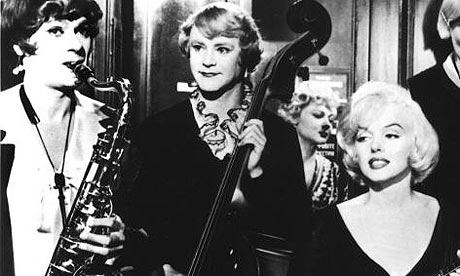
Whenever I watch Some Like It Hot I am perplexed by the end.  Osgood really does not care?  Did he know that Jack Lemmon was a man the whole time?  And why does Jack Lemmon seem alright with the whole thing?  Even earlier when Osgood proposed to him, Jack Lemmon seems determined to marry.  It is not until Tony Curtis yells at him and talks some sense into him that Lemmon realizes that he just cannot marry Osgood.  It makes me wonder whether the movie has any type of serious agenda.  I do not think so because it is such a screwball comedy but it does make me wonder.

I read that Monroe was a nightmare on this set, showing up late and taking upwards of forty takes to do some scenes.  I cannot say I know enough of her work to say whether she is a good actor.  Some scenes do seem forced and the whole 'dumb blonde' thing grows tiresome.  But she is perfect for the role of an 'innocent' sex-pot, but is no match for the wits and banter of Lemmon and Curtis.  She died only three years after this movie was made, and I know that she battled mental illness and substance abuse which could certainly lead to poor work performance.  It makes me think of Lindsay Lohan.  Perhaps it is that whole Hollywood machine thing:  chews you up and spits you out.


Network was an unexpectedly amazing movie.  I knew that it was supposed to be good.  It had Robert Duvall, Faye Dunaway and William Holden.  It was nominated for ten Oscars, five of them for acting, and it won four Oscars.  It is a critique of television that was pertinent then in 1976 and is still pertinent.  It talks about how television informs everything about our lives, how life eventually imitates art that imitates life, and how that constant copying degrades into a life devoid of real human connection.  The Howard Beale Show is about how television reaches its broadest audience when it panders to lowest common denominator.  Network tells us that our beliefs and thus our souls are subject to the ratings and that any ideals can be bought and sold.  That is what Ned Beatty's character would tell us, we live in a "dominion of dollars".  This is the second movie I've seen with Faye Dunaway (Chinatown the first) and she is amazing.  I have yet to see Bonnie & Clyde or The Thomas Crown Affair but I cannot wait.  She is a real acting tour de force, one of few who come along.

Tuesday, March 15, 2011

Music In Movies: Friend Or Foe?


I recently wrote about the important of sound in movies.  It's one of those overlooked but integral parts of filmmaking.  It's not necessarily about making epic battles sound right, but doors creaking and closing too.  As important as sound is, I'd like to talk today about my love/hate relationship with music in the movies.

There are a few ways that music exist in the movies: (1) dramatic music or music that is scored to be played over scenes in movies for dramatic, comic, thrilling etc., effect; (2)  popular songs that are played over scenes also for dramatic effect; (3) music that eminates from a source within the scene of a movie.  I hate the first, am torn on the second, and am a total advocate for the third.  Dramatic, originally scored music just pisses me off.  It exists solely to evoke emotion from the audience and it is completely artificial to the story.  It's one of those things that just yanks me out of a movie and I am immediately aware that I'm watching a movie.  The worst experience I can remember in regards to this heavy-handed nonsense is Crash (2004).  Half of the God-damned movie was shots of the characters standing around and looking pensive, all to the sounds of some sappy, bullshit music that's supposed to make me feel bad that Matt Dillon is a racist asshole.  The are times I can tolerate it.  A lot of classic films are scored and I usually let it slide, consider it a sign of the times, nothing more.  It is a bit distracting at times, it's my biggest issue with Hitchcock.  (Among other issues.)  Most recently, when I saw Inception, I hardly remembered the music and I know that was scored.  Although I have heard that all the music is supposed to be a derivation of the Edith Piaf song that is integral to the story, and eminates from a source within the film.  Maybe it gets off on a technicality.  It was a good sign that when talking about the film with a friend after having recently seen it, I couldn't remember the music.  I suppose it had gelled with the film well.  Perhaps action films are better suitors for scored music.  There are some scores that are great.  Just about anything Ennio Morricone does is amazing and a lot of great Noir films owe much of their mood to scores:  Elevator to the Gallows (1958), Chinatown (1974), L.A. Confidential (1997) just to name a few.  There are many exceptions, but they are just that, exceptions.

The second iteration of music in films is popular songs being used in the same way as scored music:  played over scenes to evoke emotion from the audience.  Again a cheap tactic, a crutch on the part of the director to get under our skin.  Some might say that the music is part of the whole vision that the director has, but as a viewer it feels cheap and easy.  And I don't like the things I like to be cheap and easy.  However, I am torn in regard to this type of music because this type of music is the reason for most of the great soundtracks ever:  Super Fly (1972), The Graduate (1967), Purple Rain (1984), Easy Rider (1969), and just about every Quentin Tarantino film.  Jackie Brown (1997) is perhaps my favorite soundtrack ever and the music works great in that movie, except for the useless and irritating scene with The Firm song playing.  What can I say, I'm a sucker for Strawberry Letter #23.  Pop songs have also been used for bad, such as every 80s movie montage ever.  Enjoy this Rocky IV clip.  I love this song unironically, especially the bass in the beginning.


These montages exist to further along the plot but don't require any real acting.  Mainly you just need a good editor, not to understate editors.  It's just another crutch.  Instead of evoking emotion, the director furthers things along, tells us something that would take a while and compresses it into a four and a half minute montage.  The above video for instance, shows Rocky trying to decide what to do now that Apollo is dead and Adrian doesn't want him to fight Drago.  But within four minutes Rocky knows what must be done for the sake of his friends memory and patriotism, yadda yadda yadda.  The decision to fight someone whose just killed your best friend and might do irreparable brain damage to you is not one to be taken lightly.  That could be a movie in itself.  So, popular songs have the same problem as the scored music, it's artificial to the scene.

The last type of music is music that emanates from within the context of the movie:  a car radio, a band, a loudspeaker at the mall.  This music is organic, is a part of the world in which the characters live, adding to the authenticity of that world.  In a movie that has music dubbed over the scenes I feel like the viewer of a movie; in a movie with music that originates from within the scene, I feel like the viewer of something that would be happening even if I wasn't watching.  The HBO show The Wire only featured music that was in the scene which helped to bring the reality of the city of Baltimore alive.  It's all about authenticity and being organic. 

Oh and musicals.  They're musicals:  there's music in 'em.