Tuesday, March 29, 2011

Veronica Mars or: How I Learned To Stop Being An Elitist And Fall For A Teen Soap Opera


(Warning: Spoilers for HBO's The Wire.)

I haven't watched a movie recently.  I watched Animal Kingdom a week ago, and what an amazing film it is.  Go see it if you haven't already.  But since then I have have watched nothing but Veronica Mars.  For those playing the home game, Veronica Mars is a teen soap opera about a girl who solves mysteries.  Think Chinatown meets One Tree Hill.  At first it didn't seem as bad as all that.  The first season had an overarching murder mystery that had defined the status quo of the show.  Each episode had its own 'mini-mystery' and the overarching plot was prodded along little by little, keeping me interested like an animal following a trail of crumbs.  Only this trail of crumbs led to an addiction to a soap opera.  Now, in the second season, the big mystery of the first season has been solved and the show just seems to manufacture new connections between characters and creates convoluted and dubious storyline arcs for the sake of maintaining high drama.  Virtually every character, besides the eponymous Ms. Mars, is flat and uninteresting.  New characters spring up every episode just to fill the the template of 'new stupid mystery.'  Old characters that were seemingly throwaways come back just to fill ridiculous plot holes.  And yet I cannot stop watching.  Although I must say the character of Veronica Mars is interesting.  She's snarky and capable, and Kristen Bell is a good actress.  It reminds me of Dexter in that way:  there's a character who is interesting, facing conflict, moving forward, being human and then the world around them is populated simply to make it seem like they live in a real world.  If people were really this vapid...wait maybe people really are this vapid. 

I'm veering off course here.  My point is that I Am Hooked.  I see all of these ridiculous and contrived plots, these flat and also ridiculously contrived characters and yet I can't get enough.  I won't stop until I've watched all 64 episodes.  That's right, 64!  I'm up to the 34th and it won't stop.  It really doesn't help that Netflix has all episodes on Instant Watch.  Recently, Netflix compressed all their television shows into single entries.  So every season of Veronica Mars can be found under Veronica Mars.  No longer is it separated by season.  Now that I think about it this is really Netflix's fault.  How can I be expected to stop watching just because I finish a season.  Every episode is listed 1-64.  I have to finish what I started.  Thanks Netflix.

I finally understand the soap opera phenomenon.  Watch one episode and it's silly drama, but watch everyday and you get sucked in.  You see the seams and cracks in the facade but you stay around.  I stay around for the comfort.  I know these characters.  I know what to expect from the show in general.  They won't pull any punches on me.  Stringer Bell won't be killed to serve the plot.  Serve me dammit!


Oh and the way I started watching this show is because it has the same creator as Starz's amazing, underrated and hysterical show Party Down.  Watch Party Down!

Monday, March 21, 2011

This Weekend In Movies...for me at least


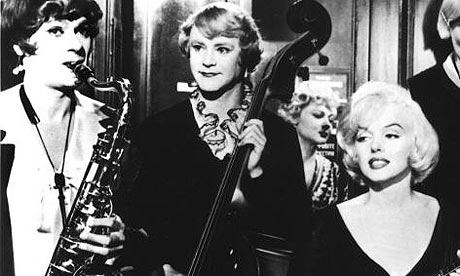
This past weekend was a good one.  The weather was perfect for a couple trips to the dog park.  There was much relaxing and lazing around.  The smell of home cooked meals filled my apartment each night and most of all, there was a movie each night.  Sometimes it is difficult to find time for movies.  Like a pro athlete, I go through hot streaks and slumps.  I think July of 2010 has my highest tally for movies watched, somewhere around 27.  I was working part time at a job with little to do, so my Netflix Instant queue eroded ever so slightly.  Since then it has been rough but this weekend provided a nice variety of film viewing.  On Friday night my girlfriend and I went to see The King's Speech, Saturday I watched always hilarious Some Like It Hot, and Sunday I finally watched Network.  All in all, a damn good weekend of movies.


Initially, I was not interested in seeing The King's Speech because (1) it seemed like your typical Oscar winning, high drama, easy to swallow period piece and (2) the estimable Riku of RikuWrites fame said that it "had the story arc of a modern day sports picture."  But it was nominated for twelve Oscars and won four including Best Dirctor, Best Picture and Colin Firth won Best Actor.  Even though I disdain the Academy Awards and their dubious practices, they can be a good barometer of movies worth seeing.  Also, my girlfriend wanted to see it.  Overall, it was okay.  I guess it's sort of a 'meh' movie.  It does follow the sports movie arc, which is the same as the Cinderella arc.  Here is a diagram compliments of Lapshamquarterly.org and Kurt Vonnegut:


There were some funny lines and great opportunities for banter, but they were spoiled by constant cutting.  The director, Tom Hooper, inserted too many cuts into scenes between Geoffrey Rush and Colin Firth that could have been great.  These are two great actors that don't really have a chance to stretch out.  There are too many back and forth shots during conversations.  I would have liked two-shots that lasted more than ten seconds, to build some tension, to let the actors breathe a little.  By the end I did not really care, I knew how it would end and was just waiting for the moment when he gave the titular speech.  Oh, but Guy Pearce was in it and he's awesome.


Whenever I watch Some Like It Hot I am perplexed by the end.  Osgood really does not care?  Did he know that Jack Lemmon was a man the whole time?  And why does Jack Lemmon seem alright with the whole thing?  Even earlier when Osgood proposed to him, Jack Lemmon seems determined to marry.  It is not until Tony Curtis yells at him and talks some sense into him that Lemmon realizes that he just cannot marry Osgood.  It makes me wonder whether the movie has any type of serious agenda.  I do not think so because it is such a screwball comedy but it does make me wonder.

I read that Monroe was a nightmare on this set, showing up late and taking upwards of forty takes to do some scenes.  I cannot say I know enough of her work to say whether she is a good actor.  Some scenes do seem forced and the whole 'dumb blonde' thing grows tiresome.  But she is perfect for the role of an 'innocent' sex-pot, but is no match for the wits and banter of Lemmon and Curtis.  She died only three years after this movie was made, and I know that she battled mental illness and substance abuse which could certainly lead to poor work performance.  It makes me think of Lindsay Lohan.  Perhaps it is that whole Hollywood machine thing:  chews you up and spits you out.


Network was an unexpectedly amazing movie.  I knew that it was supposed to be good.  It had Robert Duvall, Faye Dunaway and William Holden.  It was nominated for ten Oscars, five of them for acting, and it won four Oscars.  It is a critique of television that was pertinent then in 1976 and is still pertinent.  It talks about how television informs everything about our lives, how life eventually imitates art that imitates life, and how that constant copying degrades into a life devoid of real human connection.  The Howard Beale Show is about how television reaches its broadest audience when it panders to lowest common denominator.  Network tells us that our beliefs and thus our souls are subject to the ratings and that any ideals can be bought and sold.  That is what Ned Beatty's character would tell us, we live in a "dominion of dollars".  This is the second movie I've seen with Faye Dunaway (Chinatown the first) and she is amazing.  I have yet to see Bonnie & Clyde or The Thomas Crown Affair but I cannot wait.  She is a real acting tour de force, one of few who come along.

Tuesday, March 15, 2011

Music In Movies: Friend Or Foe?


I recently wrote about the important of sound in movies.  It's one of those overlooked but integral parts of filmmaking.  It's not necessarily about making epic battles sound right, but doors creaking and closing too.  As important as sound is, I'd like to talk today about my love/hate relationship with music in the movies.

There are a few ways that music exist in the movies: (1) dramatic music or music that is scored to be played over scenes in movies for dramatic, comic, thrilling etc., effect; (2)  popular songs that are played over scenes also for dramatic effect; (3) music that eminates from a source within the scene of a movie.  I hate the first, am torn on the second, and am a total advocate for the third.  Dramatic, originally scored music just pisses me off.  It exists solely to evoke emotion from the audience and it is completely artificial to the story.  It's one of those things that just yanks me out of a movie and I am immediately aware that I'm watching a movie.  The worst experience I can remember in regards to this heavy-handed nonsense is Crash (2004).  Half of the God-damned movie was shots of the characters standing around and looking pensive, all to the sounds of some sappy, bullshit music that's supposed to make me feel bad that Matt Dillon is a racist asshole.  The are times I can tolerate it.  A lot of classic films are scored and I usually let it slide, consider it a sign of the times, nothing more.  It is a bit distracting at times, it's my biggest issue with Hitchcock.  (Among other issues.)  Most recently, when I saw Inception, I hardly remembered the music and I know that was scored.  Although I have heard that all the music is supposed to be a derivation of the Edith Piaf song that is integral to the story, and eminates from a source within the film.  Maybe it gets off on a technicality.  It was a good sign that when talking about the film with a friend after having recently seen it, I couldn't remember the music.  I suppose it had gelled with the film well.  Perhaps action films are better suitors for scored music.  There are some scores that are great.  Just about anything Ennio Morricone does is amazing and a lot of great Noir films owe much of their mood to scores:  Elevator to the Gallows (1958), Chinatown (1974), L.A. Confidential (1997) just to name a few.  There are many exceptions, but they are just that, exceptions.

The second iteration of music in films is popular songs being used in the same way as scored music:  played over scenes to evoke emotion from the audience.  Again a cheap tactic, a crutch on the part of the director to get under our skin.  Some might say that the music is part of the whole vision that the director has, but as a viewer it feels cheap and easy.  And I don't like the things I like to be cheap and easy.  However, I am torn in regard to this type of music because this type of music is the reason for most of the great soundtracks ever:  Super Fly (1972), The Graduate (1967), Purple Rain (1984), Easy Rider (1969), and just about every Quentin Tarantino film.  Jackie Brown (1997) is perhaps my favorite soundtrack ever and the music works great in that movie, except for the useless and irritating scene with The Firm song playing.  What can I say, I'm a sucker for Strawberry Letter #23.  Pop songs have also been used for bad, such as every 80s movie montage ever.  Enjoy this Rocky IV clip.  I love this song unironically, especially the bass in the beginning.


These montages exist to further along the plot but don't require any real acting.  Mainly you just need a good editor, not to understate editors.  It's just another crutch.  Instead of evoking emotion, the director furthers things along, tells us something that would take a while and compresses it into a four and a half minute montage.  The above video for instance, shows Rocky trying to decide what to do now that Apollo is dead and Adrian doesn't want him to fight Drago.  But within four minutes Rocky knows what must be done for the sake of his friends memory and patriotism, yadda yadda yadda.  The decision to fight someone whose just killed your best friend and might do irreparable brain damage to you is not one to be taken lightly.  That could be a movie in itself.  So, popular songs have the same problem as the scored music, it's artificial to the scene.

The last type of music is music that emanates from within the context of the movie:  a car radio, a band, a loudspeaker at the mall.  This music is organic, is a part of the world in which the characters live, adding to the authenticity of that world.  In a movie that has music dubbed over the scenes I feel like the viewer of a movie; in a movie with music that originates from within the scene, I feel like the viewer of something that would be happening even if I wasn't watching.  The HBO show The Wire only featured music that was in the scene which helped to bring the reality of the city of Baltimore alive.  It's all about authenticity and being organic. 

Oh and musicals.  They're musicals:  there's music in 'em.

Wednesday, March 9, 2011

Treading Old Waters: Hey, I've Seen This Before!


In the spectrum of movie rating, where the extremes are "Loved It" and "Hated It", most movies end up somewhere in the middle.  It's not often a movie completely endears itself to me or completely alienates me.  However, this has a positive result.  I tend to revisit the movies that I am most conflicted about more than any I've loved or hated.  I suppose I'm looking to be won over: perhaps I didn't submit myself completely the first time.  Thus Treading Old Waters, my thoughts on a film after another go 'round.

The second time you watch a movie can be a very different experience from the first time.  Since you have seen the movie, you may notice things you didn't before because you are not as focused on what is happening. You have time to appreciate the cinematography, or notice what's in the frame besides the main focus of that shot.  Perhaps you didn't fully grasp that plot and a second time through can illuminate and clarify some things for you, really changing your experience of the film.  Usually, the biggest difference for me is the pacing.  I think of it like this:  you're going on a trip, could be local or long distance, you've got your directions or map in hand, you know where you're going;  the first time you take that trip feels interminably long, simply because although you know where you're going you have no frame of reference, no landmarks.  Every subsequent trip feels much shorter because there is no question of where you're going.  The best example I can offer is There Will Be Blood.  It's a fairly long film, clocking in at over two and a half hours.  In the theater I liked it, but it felt long, I found myself looking at the wall every now and then.  It wasn't until I saw it on DVD that I found myself excited about certain parts of the film, waiting for the proselytizing of Daniel Plainview or Paul Sunday.  We owe it to films and filmmakers to revisit and re-assess, to reconsider what time may have done to a film or to ourselves.  As an amateur, movie-blogging nobody, I know that I only see many movies once because I've got so many others waiting.  So here's to the second chance.  (I also recommend watching foreign films a second time without the subtitles.)

L.A. Confidential is a movie I thought I would like even before seeing it.  I am a sucker for Noir, even at it's hammiest moments.  (For non-hammie Noir, see The Third Man.L.A. Confidential has all the qualities of the typical Noir story:  hardboiled detectives, sultry dames, seedy thugs, and trip into the shadowy underworld of L.A. in the 50s.  There's police corruption, glamorous Hollywood starlets and conspiracies that unfold to reveal the great cynicism beneath the glitz of Hollywood's Golden Age.  Teh overarching story is about the take-over of Hollywood's black market by unknown persons, but before that can be addressed there are many zigs and zags in the spiderweb that is the L.A.  There's good acting all around from James Cromwell, Guy Pearce, Russell Crowe, Danny Devito and Kevin Spacey.  Kim Basinger brings up the rear with plenty of overacting for everyone. 

First Viewing:  I liked it.  It was a solid film that gains much of its strength from its source material by James Ellroy.  But there was good acting and it maintained a steady beat throughout.  That steady pace was strong until about the end of the film which altered the movie from an interesting drama and study of the nature of corruption into a typical Hollywood action movie.  It really killed the mood and all the great tension that had been built up.  Overall it was the kind of movie I didn't think could be made anymore.  It succeeds in not being an homage to older Noir films, but rather succeeds on its own.  It could easily have become a parody of itself, or ultimately aware of itself as a movie that is obviously out of its time.  Instead it is welcomed addition to the Noir canon.

Second Viewing:  My overall reaction was the same, I think I liked it more actually.  The ending action sequence was not as off-putting as in the first viewing.  It didn't feel as drawn out and seemed to organic to a major theme in the film:  all things end in violence.  The acting showed its seems more this time around, especially in the case of Kim Basinger, who seemed to think that she was starring in an homage to Noir cinema.  She was too much, a parody of the femme fatale.  I was, however, endeared to Russell Crowe, who I usually don't like much but really nails the brawn-over-brains cop against Pearce's well played brains-over-brawn cop.  My biggest gripe after a second viewing is some of the cinematography.  During some dramatic scenes the camera zooms in to enhance the dramatic nature of the scene, but succeeds only in making the viewer aware of the camera.  One scene in particular, which is a romantic scene between Basinger and Crowe, culminates just before the cut in them falling on the bed together and the camera moving in and showing us the scene through the slats on the bedframe.  That camera movement drags me right out of the scene.  I know that's a bit specific, especially without a clip, but I couldn't find a clip to really illustrate the point.  However, this type of heavy handed camera work doesn't occur often in the movie and doesn't ruin the film overall.  In fact, L.A. Confidential is a great piece of cinema that should not be missed.  One thing it does lack is a strong female role that does not exist solely in relation to a man.  But folks, this is Noir.