Wednesday, June 8, 2011

Getting My Groove Back: Two Movies That Got Me Writing Again


It's been a long while since I posted anything on here.  I suppose very few people read this.  One friend I work with does and he tells me to write more, but hell, I could just tell him what I think about the application of Oscar Wilde's theory on art as it applies to Drive Angry 3D.  Another reason why I haven't written much lately is because I haven't really watched any movies lately.  But I just watched two yesterday and I liked them both so much I thought I should write something abou them, knowing that I will inevitably lose the interest and drive to do anything mildly taxing on my mind.  So here it goes.

The first movie I watched yesterday was The Conversation (1974), a suspenseful tale about a surveillance expert who becomes increasingly involved in his most recent recording job when he believes the subjects are in danger of being murdered.  If that sounds convoluted, I'm sorry, just trying to sum it all up easily.  Gene Hackman plays the lead role of the surveillance expert and turns in a great performance with minimal dialogue.  John Cazale (who only made five films due to his untimely death at 42, but all five are amazing) gives a great performance as Hackman's employee.  There are a couple other good cameos as well, but I won't spoil them for all one of you that will read this.  The Conversation plays very much like a standard thriller, building slowly and leading us along the bread crumb trail.  It moves slowly allowing for good scene development and tension.  There are great static shots that the characters move in and out of, mimicking surveillance cameras.  (There's a shot at the end that does this perfectly.)  The feeling is that of 1984, you are being watched, you are not in control. 


These are the things that make it a good movie, but what makes it great and really worth watching is the character that Hackman plays, Harry Caul.  As the movie progresses we not only do we learn more about the current case but we learn more about Harry, a paranoid and extremely secretive man who is cut off from humanity, an ironic twist considering his profession.  Coppola gives enough to make Harry real and deep, but doesn't give us too much, allowing Hackman and the building tension to help us build our own conclusions.  This is what good filmmaking does: it leaves us with questions as well as answers, it asks the audience to fill  in what's missing between frames.  It wants more than emotional investment and empathy.  It pushes us away to engage us, rather than pulling us in. 


The second movie I watched yesterday was Visioneers (2008), a dark comedy starring Zach Galifianakis as George Washington Winsterhammerman a corporate drone whose ennui is at the tipping point as the people of the world start to explode.  (Yep, you read that right, explode.)  The movie is informed by the ideas of Huxley's Brave New World and the works of Neil Postman, that love and excess and distraction would be the death of humanity.  The movie is very funny in it's absurdity.  It also reminded me of the films by Mike Judge.  It's not very silly, just off-beat and not what you'd expect.  I recommend it on the basis that at least it's different, not just your run of the mill comedy bullshit. 

My girlfriend and I got it on  whim at the Redbox.  She said, "you like that Zach Galifianakis guy, he makes you laugh."  And it's true, he does, especially in the current state of insipid comedy films.  But I wasn't excited, I wanted to get Biutiful, the Oscar Nominee.  But I had a hard time sticking up for a movie about coping with a terminal illness that would surely end on a low note.  So, she suggested we put it on last night, and I did and she fell asleep and I watched it and liked it.  It gave me faith that Galifianakis isn't just a one trick pony, that he can do a serious role.  Perhaps I liked it so much because I didn't have high expectations, but I still recommend it and would say it's not a waste of time.

Tuesday, March 29, 2011

Veronica Mars or: How I Learned To Stop Being An Elitist And Fall For A Teen Soap Opera


(Warning: Spoilers for HBO's The Wire.)

I haven't watched a movie recently.  I watched Animal Kingdom a week ago, and what an amazing film it is.  Go see it if you haven't already.  But since then I have have watched nothing but Veronica Mars.  For those playing the home game, Veronica Mars is a teen soap opera about a girl who solves mysteries.  Think Chinatown meets One Tree Hill.  At first it didn't seem as bad as all that.  The first season had an overarching murder mystery that had defined the status quo of the show.  Each episode had its own 'mini-mystery' and the overarching plot was prodded along little by little, keeping me interested like an animal following a trail of crumbs.  Only this trail of crumbs led to an addiction to a soap opera.  Now, in the second season, the big mystery of the first season has been solved and the show just seems to manufacture new connections between characters and creates convoluted and dubious storyline arcs for the sake of maintaining high drama.  Virtually every character, besides the eponymous Ms. Mars, is flat and uninteresting.  New characters spring up every episode just to fill the the template of 'new stupid mystery.'  Old characters that were seemingly throwaways come back just to fill ridiculous plot holes.  And yet I cannot stop watching.  Although I must say the character of Veronica Mars is interesting.  She's snarky and capable, and Kristen Bell is a good actress.  It reminds me of Dexter in that way:  there's a character who is interesting, facing conflict, moving forward, being human and then the world around them is populated simply to make it seem like they live in a real world.  If people were really this vapid...wait maybe people really are this vapid. 

I'm veering off course here.  My point is that I Am Hooked.  I see all of these ridiculous and contrived plots, these flat and also ridiculously contrived characters and yet I can't get enough.  I won't stop until I've watched all 64 episodes.  That's right, 64!  I'm up to the 34th and it won't stop.  It really doesn't help that Netflix has all episodes on Instant Watch.  Recently, Netflix compressed all their television shows into single entries.  So every season of Veronica Mars can be found under Veronica Mars.  No longer is it separated by season.  Now that I think about it this is really Netflix's fault.  How can I be expected to stop watching just because I finish a season.  Every episode is listed 1-64.  I have to finish what I started.  Thanks Netflix.

I finally understand the soap opera phenomenon.  Watch one episode and it's silly drama, but watch everyday and you get sucked in.  You see the seams and cracks in the facade but you stay around.  I stay around for the comfort.  I know these characters.  I know what to expect from the show in general.  They won't pull any punches on me.  Stringer Bell won't be killed to serve the plot.  Serve me dammit!


Oh and the way I started watching this show is because it has the same creator as Starz's amazing, underrated and hysterical show Party Down.  Watch Party Down!

Monday, March 21, 2011

This Weekend In Movies...for me at least


This past weekend was a good one.  The weather was perfect for a couple trips to the dog park.  There was much relaxing and lazing around.  The smell of home cooked meals filled my apartment each night and most of all, there was a movie each night.  Sometimes it is difficult to find time for movies.  Like a pro athlete, I go through hot streaks and slumps.  I think July of 2010 has my highest tally for movies watched, somewhere around 27.  I was working part time at a job with little to do, so my Netflix Instant queue eroded ever so slightly.  Since then it has been rough but this weekend provided a nice variety of film viewing.  On Friday night my girlfriend and I went to see The King's Speech, Saturday I watched always hilarious Some Like It Hot, and Sunday I finally watched Network.  All in all, a damn good weekend of movies.


Initially, I was not interested in seeing The King's Speech because (1) it seemed like your typical Oscar winning, high drama, easy to swallow period piece and (2) the estimable Riku of RikuWrites fame said that it "had the story arc of a modern day sports picture."  But it was nominated for twelve Oscars and won four including Best Dirctor, Best Picture and Colin Firth won Best Actor.  Even though I disdain the Academy Awards and their dubious practices, they can be a good barometer of movies worth seeing.  Also, my girlfriend wanted to see it.  Overall, it was okay.  I guess it's sort of a 'meh' movie.  It does follow the sports movie arc, which is the same as the Cinderella arc.  Here is a diagram compliments of Lapshamquarterly.org and Kurt Vonnegut:


There were some funny lines and great opportunities for banter, but they were spoiled by constant cutting.  The director, Tom Hooper, inserted too many cuts into scenes between Geoffrey Rush and Colin Firth that could have been great.  These are two great actors that don't really have a chance to stretch out.  There are too many back and forth shots during conversations.  I would have liked two-shots that lasted more than ten seconds, to build some tension, to let the actors breathe a little.  By the end I did not really care, I knew how it would end and was just waiting for the moment when he gave the titular speech.  Oh, but Guy Pearce was in it and he's awesome.


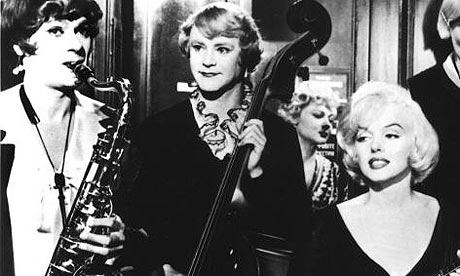
Whenever I watch Some Like It Hot I am perplexed by the end.  Osgood really does not care?  Did he know that Jack Lemmon was a man the whole time?  And why does Jack Lemmon seem alright with the whole thing?  Even earlier when Osgood proposed to him, Jack Lemmon seems determined to marry.  It is not until Tony Curtis yells at him and talks some sense into him that Lemmon realizes that he just cannot marry Osgood.  It makes me wonder whether the movie has any type of serious agenda.  I do not think so because it is such a screwball comedy but it does make me wonder.

I read that Monroe was a nightmare on this set, showing up late and taking upwards of forty takes to do some scenes.  I cannot say I know enough of her work to say whether she is a good actor.  Some scenes do seem forced and the whole 'dumb blonde' thing grows tiresome.  But she is perfect for the role of an 'innocent' sex-pot, but is no match for the wits and banter of Lemmon and Curtis.  She died only three years after this movie was made, and I know that she battled mental illness and substance abuse which could certainly lead to poor work performance.  It makes me think of Lindsay Lohan.  Perhaps it is that whole Hollywood machine thing:  chews you up and spits you out.


Network was an unexpectedly amazing movie.  I knew that it was supposed to be good.  It had Robert Duvall, Faye Dunaway and William Holden.  It was nominated for ten Oscars, five of them for acting, and it won four Oscars.  It is a critique of television that was pertinent then in 1976 and is still pertinent.  It talks about how television informs everything about our lives, how life eventually imitates art that imitates life, and how that constant copying degrades into a life devoid of real human connection.  The Howard Beale Show is about how television reaches its broadest audience when it panders to lowest common denominator.  Network tells us that our beliefs and thus our souls are subject to the ratings and that any ideals can be bought and sold.  That is what Ned Beatty's character would tell us, we live in a "dominion of dollars".  This is the second movie I've seen with Faye Dunaway (Chinatown the first) and she is amazing.  I have yet to see Bonnie & Clyde or The Thomas Crown Affair but I cannot wait.  She is a real acting tour de force, one of few who come along.

Tuesday, March 15, 2011

Music In Movies: Friend Or Foe?


I recently wrote about the important of sound in movies.  It's one of those overlooked but integral parts of filmmaking.  It's not necessarily about making epic battles sound right, but doors creaking and closing too.  As important as sound is, I'd like to talk today about my love/hate relationship with music in the movies.

There are a few ways that music exist in the movies: (1) dramatic music or music that is scored to be played over scenes in movies for dramatic, comic, thrilling etc., effect; (2)  popular songs that are played over scenes also for dramatic effect; (3) music that eminates from a source within the scene of a movie.  I hate the first, am torn on the second, and am a total advocate for the third.  Dramatic, originally scored music just pisses me off.  It exists solely to evoke emotion from the audience and it is completely artificial to the story.  It's one of those things that just yanks me out of a movie and I am immediately aware that I'm watching a movie.  The worst experience I can remember in regards to this heavy-handed nonsense is Crash (2004).  Half of the God-damned movie was shots of the characters standing around and looking pensive, all to the sounds of some sappy, bullshit music that's supposed to make me feel bad that Matt Dillon is a racist asshole.  The are times I can tolerate it.  A lot of classic films are scored and I usually let it slide, consider it a sign of the times, nothing more.  It is a bit distracting at times, it's my biggest issue with Hitchcock.  (Among other issues.)  Most recently, when I saw Inception, I hardly remembered the music and I know that was scored.  Although I have heard that all the music is supposed to be a derivation of the Edith Piaf song that is integral to the story, and eminates from a source within the film.  Maybe it gets off on a technicality.  It was a good sign that when talking about the film with a friend after having recently seen it, I couldn't remember the music.  I suppose it had gelled with the film well.  Perhaps action films are better suitors for scored music.  There are some scores that are great.  Just about anything Ennio Morricone does is amazing and a lot of great Noir films owe much of their mood to scores:  Elevator to the Gallows (1958), Chinatown (1974), L.A. Confidential (1997) just to name a few.  There are many exceptions, but they are just that, exceptions.

The second iteration of music in films is popular songs being used in the same way as scored music:  played over scenes to evoke emotion from the audience.  Again a cheap tactic, a crutch on the part of the director to get under our skin.  Some might say that the music is part of the whole vision that the director has, but as a viewer it feels cheap and easy.  And I don't like the things I like to be cheap and easy.  However, I am torn in regard to this type of music because this type of music is the reason for most of the great soundtracks ever:  Super Fly (1972), The Graduate (1967), Purple Rain (1984), Easy Rider (1969), and just about every Quentin Tarantino film.  Jackie Brown (1997) is perhaps my favorite soundtrack ever and the music works great in that movie, except for the useless and irritating scene with The Firm song playing.  What can I say, I'm a sucker for Strawberry Letter #23.  Pop songs have also been used for bad, such as every 80s movie montage ever.  Enjoy this Rocky IV clip.  I love this song unironically, especially the bass in the beginning.


These montages exist to further along the plot but don't require any real acting.  Mainly you just need a good editor, not to understate editors.  It's just another crutch.  Instead of evoking emotion, the director furthers things along, tells us something that would take a while and compresses it into a four and a half minute montage.  The above video for instance, shows Rocky trying to decide what to do now that Apollo is dead and Adrian doesn't want him to fight Drago.  But within four minutes Rocky knows what must be done for the sake of his friends memory and patriotism, yadda yadda yadda.  The decision to fight someone whose just killed your best friend and might do irreparable brain damage to you is not one to be taken lightly.  That could be a movie in itself.  So, popular songs have the same problem as the scored music, it's artificial to the scene.

The last type of music is music that emanates from within the context of the movie:  a car radio, a band, a loudspeaker at the mall.  This music is organic, is a part of the world in which the characters live, adding to the authenticity of that world.  In a movie that has music dubbed over the scenes I feel like the viewer of a movie; in a movie with music that originates from within the scene, I feel like the viewer of something that would be happening even if I wasn't watching.  The HBO show The Wire only featured music that was in the scene which helped to bring the reality of the city of Baltimore alive.  It's all about authenticity and being organic. 

Oh and musicals.  They're musicals:  there's music in 'em.

Wednesday, March 9, 2011

Treading Old Waters: Hey, I've Seen This Before!


In the spectrum of movie rating, where the extremes are "Loved It" and "Hated It", most movies end up somewhere in the middle.  It's not often a movie completely endears itself to me or completely alienates me.  However, this has a positive result.  I tend to revisit the movies that I am most conflicted about more than any I've loved or hated.  I suppose I'm looking to be won over: perhaps I didn't submit myself completely the first time.  Thus Treading Old Waters, my thoughts on a film after another go 'round.

The second time you watch a movie can be a very different experience from the first time.  Since you have seen the movie, you may notice things you didn't before because you are not as focused on what is happening. You have time to appreciate the cinematography, or notice what's in the frame besides the main focus of that shot.  Perhaps you didn't fully grasp that plot and a second time through can illuminate and clarify some things for you, really changing your experience of the film.  Usually, the biggest difference for me is the pacing.  I think of it like this:  you're going on a trip, could be local or long distance, you've got your directions or map in hand, you know where you're going;  the first time you take that trip feels interminably long, simply because although you know where you're going you have no frame of reference, no landmarks.  Every subsequent trip feels much shorter because there is no question of where you're going.  The best example I can offer is There Will Be Blood.  It's a fairly long film, clocking in at over two and a half hours.  In the theater I liked it, but it felt long, I found myself looking at the wall every now and then.  It wasn't until I saw it on DVD that I found myself excited about certain parts of the film, waiting for the proselytizing of Daniel Plainview or Paul Sunday.  We owe it to films and filmmakers to revisit and re-assess, to reconsider what time may have done to a film or to ourselves.  As an amateur, movie-blogging nobody, I know that I only see many movies once because I've got so many others waiting.  So here's to the second chance.  (I also recommend watching foreign films a second time without the subtitles.)

L.A. Confidential is a movie I thought I would like even before seeing it.  I am a sucker for Noir, even at it's hammiest moments.  (For non-hammie Noir, see The Third Man.L.A. Confidential has all the qualities of the typical Noir story:  hardboiled detectives, sultry dames, seedy thugs, and trip into the shadowy underworld of L.A. in the 50s.  There's police corruption, glamorous Hollywood starlets and conspiracies that unfold to reveal the great cynicism beneath the glitz of Hollywood's Golden Age.  Teh overarching story is about the take-over of Hollywood's black market by unknown persons, but before that can be addressed there are many zigs and zags in the spiderweb that is the L.A.  There's good acting all around from James Cromwell, Guy Pearce, Russell Crowe, Danny Devito and Kevin Spacey.  Kim Basinger brings up the rear with plenty of overacting for everyone. 

First Viewing:  I liked it.  It was a solid film that gains much of its strength from its source material by James Ellroy.  But there was good acting and it maintained a steady beat throughout.  That steady pace was strong until about the end of the film which altered the movie from an interesting drama and study of the nature of corruption into a typical Hollywood action movie.  It really killed the mood and all the great tension that had been built up.  Overall it was the kind of movie I didn't think could be made anymore.  It succeeds in not being an homage to older Noir films, but rather succeeds on its own.  It could easily have become a parody of itself, or ultimately aware of itself as a movie that is obviously out of its time.  Instead it is welcomed addition to the Noir canon.

Second Viewing:  My overall reaction was the same, I think I liked it more actually.  The ending action sequence was not as off-putting as in the first viewing.  It didn't feel as drawn out and seemed to organic to a major theme in the film:  all things end in violence.  The acting showed its seems more this time around, especially in the case of Kim Basinger, who seemed to think that she was starring in an homage to Noir cinema.  She was too much, a parody of the femme fatale.  I was, however, endeared to Russell Crowe, who I usually don't like much but really nails the brawn-over-brains cop against Pearce's well played brains-over-brawn cop.  My biggest gripe after a second viewing is some of the cinematography.  During some dramatic scenes the camera zooms in to enhance the dramatic nature of the scene, but succeeds only in making the viewer aware of the camera.  One scene in particular, which is a romantic scene between Basinger and Crowe, culminates just before the cut in them falling on the bed together and the camera moving in and showing us the scene through the slats on the bedframe.  That camera movement drags me right out of the scene.  I know that's a bit specific, especially without a clip, but I couldn't find a clip to really illustrate the point.  However, this type of heavy handed camera work doesn't occur often in the movie and doesn't ruin the film overall.  In fact, L.A. Confidential is a great piece of cinema that should not be missed.  One thing it does lack is a strong female role that does not exist solely in relation to a man.  But folks, this is Noir.

Tuesday, February 22, 2011

Review: Cedar Rapids


I just wanted to offer a few words on this new comedy from Office funnyman Ed Helms.  Comedy is difficult for me, I suppose it's difficult for most.  To try and predict if a movie will make me laugh is virtually impossible.  My feelings toward new comedy are apprehensive at best, same with new horror films.  And so I pretty much avoid new comedies unless I'm explicitly told by a tried and true source that I must see such-and-such.  This is how I avoided seeing The Hangover for so long.  A movie that I wrote off as another man-child adventure and this time in that most cliched of movie cities, Las Vegas.  However, one day on a trip to the supermarket, I stopped at the Redbox looking for new fare only to find nothing.  My girlfriend is always in favor of a comedy.  (I, always foreign art-house, which I guess can become tiresome.)  So I figured I'd give it a go with The Hangover, as it was the only comedy I thought might not be completely terrible.  Well, that or G-Force.  The movie was pleasant surprise that had me laughing out loud from the first paging of Dr. Faggot. 


Zach Galifianakis was the anchor of the movie with Helms and Bradley Cooper playing the straight men.  In Cedar Rapids, Helms plays the straight man again, but this time as the protagonist.  He has to play it straight for us to care about him at all and he does it well.  I don't think it's ever difficult to sympathize with him, even as the often irritating Andy Bernard.  In Rapids Helms plays a Midwestern insurance salesman, Tim Lippe,  sent to an insurance convention in the eponymous city and it is immediately apparent that this is a case of a little fish in a...er slightly bigger pond.  Hell, he's probably never been out of his one-stoplight valley town.  He's a good guide and easy to root for, but ultimately not that funny.  His best lines are ones that implicitly express his ignorance of the world around him.  Isaiah Whitlock Jr.  plays a fellow insurance salesman who plays it straight throughout.  (Except for the much talked about Omar Little dialogue.)  Not surprisingly it's John C. Reilly who gives the movie real comedy credibility.  He's irreverant and loud and just profane, but still somehow likeable.  He represents the truth underneath all the Midwestern Bible thumping.  People are fucked up and he's not scared to show it.  To put it plainly, John C. Reilly is the reason to see this movie.  There is a fairly interesting story about man who comes to terms with the darkness of world around him.  Like Blue Velvet, but with less Dennis Hopper and less disembodied ears.  There were moments that dragged, when I found myself looking at the velvet curtains in the theater.  Overall pretty good, and not a waste of time, thanks to John C. Reilly.


Thursday, February 17, 2011

A Few Words on the Importance of Sound


This is in response to an article from The New York Times entitled, 'The Sound and Feel of Oscar-Worthiness' by Melena Ryzik.

As a layperson or a simple admirer of film, it can be easy to overlook the scope of technicality that goes into costume design, makeup, visual effects, sound effects, visual and sound editing, or even cinematography. In some movies the accomplishments in these fields are more easily seen: the costumes in a period drama such as Memoirs of a Geisha (2005), or visual effects in a grand scale action piece like Transformers (2007), or the iconic make up from Frankenstein (1931).But in straight ahead, non-genre pieces that take place in present day, the effects and editing may go overlooked simply because it looks right. But it takes as much work, if not more, to truly capture a character in the present. And so through the perfection of their craft, these artists make themselves invisible and underappreciated to the general viewing public and even to the Academy members who know little to nothing of these crafts.

Sound design and sound editing are probably the most overlooked of these crafts. (I should say now that I have no technical knowledgeof sound editing or sound design. I only have what I like and believe to be important, which I suppose doesn't amount to much in this crazy world.) The cadence of footsteps matching a character's gait as they walk, the slamming of a car door, the sound that enters before the cut and thus leads us to it, these are all common effects in movies ones that we expect to be right on, because when they're not we know instinctively. Sound cues are a part of life that we don't think about much. They are a rule, like gravity, that just is and never will be any other way. The recreating of these audible cues that form the backdrop of living can be is of paramount importance to the filmmaker. Gareth Edwards, the director of the film Monsters (2010), said in an interview, (and I'm paraphrasing here) that a convincing sound and a poor image is a more convincing combination than a poor sound and even the best image. Sounds have the ability to impart information just as effectively as images. An so, in movies, sounds can tell us what's happening as opposed to showing us. Michael Haneke, director of the Palme D'or winner, The White Ribbon (2009) and Funny Games (1997) tends to have violence in his movies be obscured, as with Benny's Video (1992), or have it occur offscreen, as is Funny Games. He allows the sound impart to the viewer, or listener in this case, what's happening. And much like with reading, enables the viewer to create the image in their mind's eye: a much more effective messenger. This use of sound as a primary messenger forces the viewer to be an active participant in the story, as opposed just a consumer of it.

Sound can be used to fill narrative gaps, but it can also be used to enhance mood or setting. In the aforementioned New York Times article, the sound designer for Inception (2010), Richard King, says in regards to the multiple dream levels that dirctor Christopher Nolan "wanted there to be some kind of connection, and sound seemed to be the way to do it." The song, "Non, Je Ne Regrette Rien" that is used to signal the 'kick' for the dreamers is slowed down as we delve into deeper levels of dreaming, into a siren-like bellowing of horns, altering the mood of the scenes and creating distinctions between the various dream levels. These are more overt uses for sound design but are interwoven with the content of the story and thereby make them organic to the context of the story, which is the same as clicking footsteps and slamming doors.

I can't say much more as I am not even a novice on the logistics of sound design. I just want to point out the importance of it and encourage everyone to keep these integral but overlooked aspects of filmmaking in mind.

Well I tried to add this video to the blog but either I'm too stupid or just am not able to. Regardless, check out this video for good examples of sound editing.

Sound Design for 3 Movies

Friday, February 11, 2011


"There are eight million stories in the naked city. This is one of them."


I recently wrote up an idea I called the Film Of The Week. Unfortunately, I didn't find myself ready to write about about any of the films I saw last week. Not that I didn't have anything to say. I just couldn't muster the energy and words. So instead of painting myself into a corner with the movie of the week idea, I've decided to write whatever the hell I want. Maybe there will be movies of the week, and maybe not. How many people will actually read this anyway?

So let's talk about a neverending film and television template: the police procedural. While at one time the police procedural was fresh and gritty, a no-holds barred look at the truth of crime and criminal investigation, it is now a trite and tired concept that has been beaten into the ground. I won't say it's dead, because when done right, the police procedural can be a great story framework. The Wire, for example, used the police procedural framework to tell the story of urban life, of infrastructural collapse, of what it is to be impoverished, of ambitious politicians, and the tragedy of how chance and personal choice are friendly bedmates. The Wire was a show that required an investment of time and a reliance on the writers, that they were going to take you somewhere you'd never been before, or perhaps had been to often. It was the story of the human condition, as a is most great literature, posing as a cops-n-robbers story. Then take Law & Order, a show that is the same as breakfast on the go: it fills you up for a short while, but is ultimately forgettable. It hardly resonates beyond the credits. My favorite part of Law & Order is that unforgettable theme song. Oh, and Jerry Orbach. Probably the thing I hate most about it, and most other television-not just police procedurals, is its tidiness. This is what other people love about it, its tidiness. It follows the same beats time and time again: murder, investigation, a twist or two, arrest, courtroom, a twist or two, verdict, feeling of justice fulfilled or justice deferred, pseudo-social/moral message, Dick Wolf. This is what people want from Law & Order, little thinking, in and out in an hour flat, vicarious living.

And so the police procedural has followed in line with Law & Order. Like a travelling musician it has birthed many children, whether it knows it or not: Law & Order: Criminal Intent, Law & Order: Special Victims Unit, CSI, CSI: Miami, CSI: NY, NCIS, Numbers, NYPD Blue, Bones. And so these bastard children, no matter how seemingly different, bare resemblance to one another. There were shows prior to Law & Order that propelled the police procedural into the omnipresent genre it is today. Shows like Hill Street Blues and Miami Vice were considered fresh and different television. Steven Bochco and Michael Mann were bringing a realism to television not commonly seen: things were not always black and white and they were often dangerous, and sometimes men where pink shirts and white blazers with their sleeves rolled up. Then came Homicide: Life on the Street, a show that, in its first season, threatened to shake the viewing public out of their comfort zone. These cops smoked and were miserable, and where Miami Vice was slick and colorful and fast, Homicide was slow and brown and concerned with the how of criminal investigation, not the why. (That's another thing that gets to me: why is everyone concerned with the "why" of the crime? Investigation is driven by "how" and evidence. Everything can't be a Sherlock Holmes or Agatha Christie mystery. More stories that end tidily.) But, as the seasons of Homicide came and went the show grew tepid, conforming to network standards that would lead to better ratings. And so it just proves that we are the lifeblood of television, us and the bogus Nielsen ratings. We're to blame for the glut of these Law & Order doppelgangers. We turn it on and we turn it off. And especially now, in this The Age Of Interconnectivity, we can reach producers and directors immediately. They may listen if there's a profit margin at the end of the message.

Now that I've rambled on for too long, I'll get back to the task at hand. To review, the police procedural has had some good manifestations, but due to its overwhelming popularity has spawned a myriad of bastard children. The police procedural is on my mind because I recently watched The Naked City, the original police procedural. I was surprised at how well it held up after so many years and after having seen so many movies and television shows about cops and the legal system. It was smarter than most shows cop shows today, it actually deserves the moniker 'gritty'. It has a twisty, seedy plot filled with unsavory characters. And Barry Fitzgerald as the no-nonesense, Irish investigator. How did he not get a franchise?

I don't know exactly what all this rambling is about. I suppose just to air out some ideas.

Monday, February 7, 2011

Film Of The Week


In an effort to maintain a steady pace of writing, I am imposing on myself a column known as Film Of The Week. In this column I will write about the movie I loved most or felt was most important of that week. Since it is Tuesday I will be starting with a movie from last week and then I'll post a new one this Friday and every Friday thereafter. I doubt anyone will ever read this but, what the hell?

In this, the maiden voyage of this new column, I'll be talking about the Spike Lee film Bamboozled (2000). Years ago, before my love for film blossomed and became an obsession, I knew little of Spike Lee. I knew his reputation: a racially oriented filmmaker, adored by many, hated by just as many. A mainstay at Knicks games. It wasn't until I bought a Spike Lee movie collection for only $15. After watching these films, I really liked Spike. He's not afraid of being personal. His films are recognizable as 'Spike Lee' films, using rarely seen camera angles and a love for color. My only problem was that I always felt that he was yelling at me. He's never willing to compromise: these movies don't meet you halfway. This is cinema at gunpoint. I took offense to this; I'm here for a conversation, not a lecture. All this until Bamboozled.

Bamboozled's strength is in its subtlety. The movie is about a television writer, Damon Wayans, who creates a minstrel show for his network. After years of writing shows that don't pander to the negative stereotypes of race, Wayans' producer pushes him to writing something stereotypically black. In an effort to stick it to his boss and also get himself fired, he creates a minstrel show for the new millenium. The show takes place on a plantation and is hosted by tap dancing Man-tan (played by Savion Glover) and the joke cracking Sleep-n-eat (played by Tommy Davidson). Unfortunately, the show is not only loved by the wanna-be-black producer (played by Michael Rappaport) but is a huge success. Blackface becomes the new trend, in line with beanie babies and Pokemon. There are those who don't approve, such as Al Sharpton and Johnny Cochran and an underground group concerned with the state of blacks in America headed by none other than the Mighty Mos Def.

I'd also like to note that the movie was filmed with digital camcorders as opposed to film. At first it is jarring and uncomfortable, but as the movie progressed the style grew on me. The choice of camcorders allowed for Lee to have many cameras which lead to many angles that most movies are not shot from. The camcorders also brought a dramatized style to the story, like those dramatizations on Unsolved Mysteries. The dramatized cinematography adds to the satire in its seeming separation from reality. The film doesn't seem real in its own context, but rather a series of exaggerated events meant to provoke the viewer.

If perhaps my analysis of the film is poor, I say to you, Go See It! This is a great movie that says more about race and race relations and what the legacy of racism is in this country than any documentary you're likely to see. The best part of the movie: not knowing whether I should laugh at the minstrel show, because it was funny.

Thursday, February 3, 2011

Awards are for Winners?

In response to "Festival Films Have Minimalist Themes" by Michael Cieply, from the New York Times; "A Golden Age of Foreign Films, Mostly Unseen" by A.O. Scott; an interview with TCM host Robert Osborne at AVClub.com.

Awards season has set upon us again with the usual fervor. There are top ten lists. There are anti-top ten list essays. There are insults and compliments. There are tuxedos, golden men, best dressed lists and occasionally, movies. There's Sundance kicking off another year of seemingly countless movie festivals. There is anger and fury and love and pining of epic proportions. But I constantly come back to questioning the point of it all.

Perhaps the point is the award or the accolade, or what they really represent: acceptance, impression, a figurative pat on the back. Maybe people don't create art to win, but they certainly don't want to lose. No one wants there work to be deemed irrelevant. A Razzie might be better than the ever filling, bottomless chasm of mediocrity. Robert Osborne certainly believes in the power of the Golden Statue. In a recent interview with The A.V. Club, Robert Osborne responds to a question about the appeal of the Oscars to him by saying, "It's the great endorsement of the work being done in the movies. Not that we have that many great movies, but I believe we wouldn't have as many as we do if there wasn't an Oscar to shoot for." I never expected such cringe-worthy talk from Mr. Osborne. The man is a veritable living encyclopedia of the history of cinema, a harbinger of the power and importance of film and its everlasting resonance. Yet he thinks that the Oscar is the goal, is the bar by which standards are set. Any artist, in any medium is not setting out to win awards. It's the journey, not the destination. And anyway, the destination is not an award; it's a finished piece of art. It's a living extension of the artist. Osborne then goes on to say that the Academy Award is "the real goal" after a director gone on to "be successful and make some money." An Oscar is certainly the highest credential that a filmmaker could have on their resume. It can afford the filmmaker chance to work with people they couldn't have otherwise. It can be the cushion between a once praised filmmaker and their now crappy films. (I'm looking at you Mr. Coppola.) It opens doors. But is this really the goal?

Furthermore, let's talk about whose giving out the awards. The Academy? The Hollywood Foreign Press Association? These are the bodies that filmmakers and actors and editors and writers and all collaborators trust their work with? How many articles and general knowledge must be passed around about the dubious nature of these bodies and their decisions before we stop taking them seriously. It's the Pro Bowl, the All Star Game. It's a fucking formality. While the recognition is greeted with appreciation, consider the source. These organizations are so out of touch with the growing number of films being produced around the world. How do the Oscars only have five spots for the Best Foreign Film category? Why only one film per country? Why the language restrictions? A.O. Scott writes in a recent article from the New York Times entitled, A Golden Age of Foreign Films, Mostly Unseen, about the "peculiar and growing irrelevance of world cinema in American movie culture, which the Academy Awards help to perpetuate." I find this to be generally true. The average American moviegoer knows little of world cinema. They may know some of the Academy's choices for Best Foreign Film or they may know some older foreign films from the French New Wave or maybe a Kurosawa picture. But beyond that there is no knowledge, or interest for that matter. However, I diverge from Mr. Scott, in that, I think that with programs like Netflix, Video On Demand, and the internet in general, there has never been a greater connection to world cinema. There is a fringe element of fanboys and cinephiles and art enthusiasts around the world who are interested, who want to talk about it, and write about it, and view it. World cinema that is. It's not slowing down and films are coming from everywhere, places never expected: Romania for example. So when the potential for exposure to new types of cinema and new stories we haven't heard arises, where are we? Well, most have their heads in the sand, while some peer into the distant brightness trying to see what they can see. That much cannot be said for the illustrious institutions which set the standards for what we call great cinema, or award worthy.

Michael Cieply's article from the New York Times about the minimalist trend in films submitted to the South by Southwest festival touches on another trend in cinema. One which is in direct correlation with the economic state of things. Janet Pierson, a producer for the festival is quoted saying, "There is an economy of means at play. With the slightest of means they can grip you." Films are being made by those with the know-how but not necessarily the means. They're stripping it down, bringing it back to the core elements of story, characterization. In many cases using setting to tell a great story with little cost. Buried for instance, stars Ryan Reynolds in a coffin. It doesn't get more minimal. This is what we used to go to the movies for. Now we go for robots that turn into camaros and Pocahontas in space. All the CGI and 3D streaming digitally pales in comparison to genuine human conflict and competent storytelling. And now, with the internet, we have the information, the know-how. We can make it work because we want to. For the film's sake, for the story. Not for the trophy. In craft and especially in art, we are not competition, but conversation.